
How Long Does Psychological Testing Take?
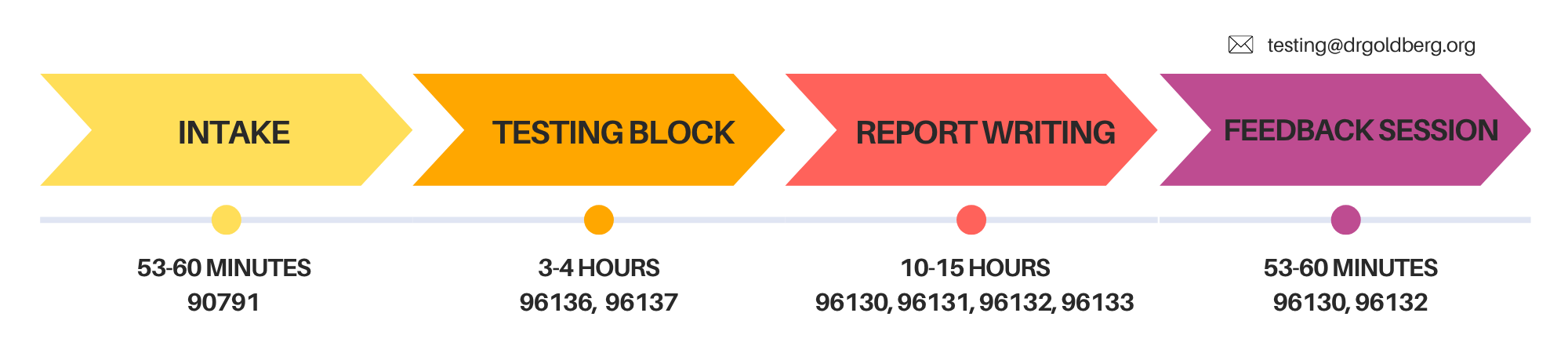
One of the most common questions we hear at Dr. Goldberg & Associates is, “How long does the psychological testing process take?”
The short answer is that psychological testing is not usually a quick process. Depending on the type of evaluation being completed, testing can take anywhere from a few hours to multiple appointments, followed by several weeks of scoring, interpretation, and report writing.
While that may sound like a significant investment of time, there is a good reason for it. Comprehensive psychological testing is designed to provide clarity, answer important diagnostic questions, and help create a roadmap for treatment, educational accommodations, or other support services.
Understanding what happens during the testing process can help you know what to expect and why quality evaluations take time.
What Is Psychological Testing?
Psychological testing is a comprehensive evaluation process used to better understand how a person thinks, learns, feels, and behaves. Unlike a brief screening questionnaire, psychological testing uses a combination of interviews, standardized assessments, rating scales, observations, and clinical expertise to provide an accurate picture of what may be contributing to a person’s symptoms.
At Dr. Goldberg & Associates, we provide evaluations for a wide range of concerns, including:
- ADHD and ADD
- Autism Spectrum Disorder
- Behavioral Disorders
- Bariatric Evaluations
- Cognitive and Intellectual Functioning
- Diagnostic Clarification
- Eating Disorders
- Executive Functioning
- Fitness for Duty Evaluations
- Immigration Hardship Evaluations
- Learning Disorders, Including Dyslexia
- Mood and Emotional Disorders
- Memory Concerns
- Neuropsychological Evaluations
- Personality Disorders
- Psychoeducational Evaluations
- Substance Use Evaluations
- Trauma and PTSD
Because every evaluation is different, the amount of time required can vary significantly.
How Long Does the Testing Appointment Take?
Most psychological testing appointments take between two and four hours.
However, some evaluations can take up to six hours depending on the complexity of the referral question and the number of tests that need to be administered.
For some patients, particularly children, completing six hours of testing in a single day may not produce the most accurate results. Mental fatigue can affect performance, concentration, and motivation.
Due to this reason, some psychologists intentionally divide testing into multiple sessions. At our practice, one provider routinely completes testing over two separate three-hour appointments. This approach helps patients stay engaged and allows the psychologist to obtain a more accurate representation of their abilities and functioning.
The goal is not to get through testing as quickly as possible. The goal is to gather the most accurate information possible.
Why Doesn’t Psychological Testing Happen in One Visit?
Many people assume psychological testing is similar to a routine doctor’s appointment where they receive answers immediately. In reality, the testing session is only one part of the evaluation process.
After testing is completed, psychologists spend considerable time:
- Scoring assessments
- Reviewing results
- Comparing data across multiple measures
- Interpreting patterns
- Ruling out alternative explanations
- Writing recommendations
- Preparing a comprehensive report
This work often takes as much time as the testing itself.
Psychological testing is not simply about assigning a diagnosis. It is about understanding the full picture of a person’s strengths, challenges, and needs.
How Long Does It Take to Receive Results?
Many patients are surprised to learn that results are not available immediately after testing.
At Dr. Goldberg & Associates, report turnaround times are typically between three and six weeks, depending on the provider’s caseload and the complexity of the evaluation.
The report-writing process alone can take up to 15 hours.
These reports are often 25 pages or longer and include detailed findings, diagnostic impressions, and personalized recommendations.
While waiting several weeks can feel frustrating, a thorough report provides significantly more value than a brief summary or checklist.
In most cases, the more time a psychologist spends analyzing and interpreting the data, the more comprehensive and useful the final report will be.
Why Comprehensive Testing Matters
One of the biggest misconceptions about psychological testing is that it is only used to confirm a diagnosis someone already suspects.
In reality, good testing is just as much about ruling out diagnoses as it is about confirming them.
For example, many adults seek testing because they believe they have ADHD. While ADHD may ultimately be diagnosed, testing may also uncover other contributing factors such as anxiety, depression, trauma, learning difficulties, executive functioning challenges, or other conditions that can create similar symptoms.
Comprehensive testing helps ensure that treatment recommendations are based on the most accurate information possible.
A Real Example of Why Thorough Testing Is Important
We once worked with a child who was referred for ADHD testing.
The family was primarily concerned about attention and focus difficulties at school and wanted answers about whether ADHD was present.
Through comprehensive testing, the psychologist identified not only ADHD but also dyslexia.
This additional information significantly changed the recommendations provided to the family.
Instead of focusing solely on ADHD treatment, the evaluation helped guide educational planning, school accommodations, and targeted interventions for reading difficulties.
Had the evaluation stopped after a simple ADHD screening, an important piece of the puzzle might have been missed.
This is one of the reasons comprehensive psychological testing can be so valuable.
Why a Formal Diagnosis Can Be Worth the Time
For many patients, one of the most valuable outcomes of psychological testing is obtaining a formal diagnosis from a licensed psychologist.
This can be important for several reasons.
Some medication management providers require comprehensive psychological testing before prescribing certain medications, including stimulant medications commonly used to treat ADHD.
Testing can also support:
- School accommodations
- College accommodations
- Workplace accommodations
- Treatment planning
- Disability documentation
- Access to specialized services
Perhaps most importantly, psychological testing provides clarity.
Many individuals spend years wondering why they are struggling. A comprehensive evaluation can help answer those questions and provide a clear path forward.
How to Prepare for Psychological Testing
One of the best pieces of advice I can offer is simple:
Be honest, not right.
There are no right or wrong answers during psychological testing.
You are not trying to pass or fail.
You are not competing against anyone.
The purpose of testing is to understand where you are right now so that recommendations can be tailored to your actual needs.
Many people feel nervous about being vulnerable, especially those who tend to be perfectionistic or highly self-critical. However, the results are only as helpful as they are accurate.
Everything discussed during the evaluation is confidential.
The more honest you are about your experiences, symptoms, strengths, and challenges, the more useful the final report will be.
In addition, try to:
- Get a good night’s sleep before testing
- Eat beforehand
- Take medications as instructed by your provider
- Arrive on time
- Bring any requested records or documentation
Being well-rested is especially important because psychological testing aims to measure your typical level of functioning. Fatigue can affect performance and potentially impact results.
The Bottom Line
Psychological testing is not a quick questionnaire or a simple screening tool. It is a comprehensive process designed to provide clarity, identify underlying concerns, and help create a roadmap for treatment and support.
While testing sessions may take several hours and reports can take weeks to complete, that time allows psychologists to thoroughly evaluate symptoms, rule out alternative explanations, and provide meaningful recommendations.
Whether you are seeking answers about ADHD, learning difficulties, autism, mood concerns, memory issues, or another mental health condition, comprehensive psychological testing can provide valuable insight into what is happening and what steps to take next.
If you are considering psychological testing and would like to learn more about the evaluation process, contact Dr. Goldberg & Associates to discuss your concerns and determine which type of assessment may be right for you.
Want to get started with the Psychological Testing and Evaluation process?
Call us at (703) 935-0058 (Option 4) or email us at testing@drgoldberg.org
Need a referral from one of our therapists for testing? Schedule an appointment with one of our therapists: Schedule for Referral
Please note that we require your therapist to see you at least 3 times before you can be referred for testing to ensure the referral is accurate.
Meet Our Testing Psychologists






Written By: